
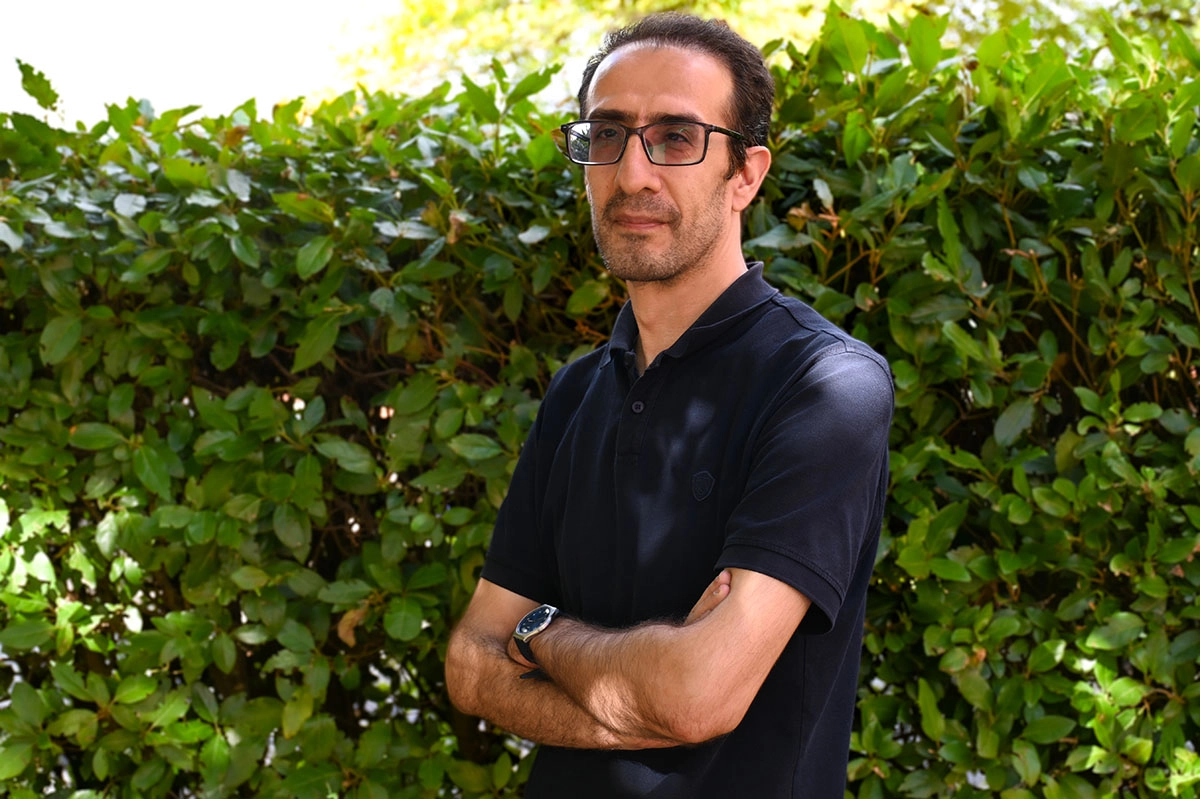
Dr Niayesh Shahmohammadi
BSc, MSc, PhD
Postdoctoral Research Fellow in Molecular Entomology
Agriculture, Health and Environment Department



Dr Niayesh Shahmohammadi joined the Natural Resources Institute (NRI), University of Greenwich, in September 2026 as a Postdoctoral Research Fellow in Molecular Entomology and Marie Skłodowska-Curie Actions (MSCA) Postdoctoral Fellow. He works in the Agriculture, Health and Environment Department on the EU-funded WhiteBrain project with Professor Maruthi M N Gowda. The project investigates how tomato yellow leaf curl virus (TYLCV) reprogrammes the brain of its whitefly vector and alters vector behaviour to enhance virus transmission, using single-cell RNA sequencing and molecular approaches.
Niayesh is a plant virologist with research expertise spanning plant virus diversity, virus-vector interactions, insect immunity, molecular entomology and transcriptomics. Before joining NRI, he was a postdoctoral researcher at Andong National University, Republic of Korea (2022-2026), where he studied molecular interactions between tomato spotted wilt virus (TSWV) and its thrips vector, Frankliniella occidentalis, with particular emphasis on oxylipin signalling, antiviral immunity, apoptosis and viral transmission. His research also investigated EpOME/DiHOME signalling in lepidopteran insects and the functional diversity of insect hemocytes using single-cell RNA sequencing and cell-type-specific fluorescence in situ hybridisation.
He completed his PhD in plant virology at the University of Tehran in 2020, examining the diversity and biology of chickpea chlorotic dwarf virus and resistance in chickpea. During his doctoral studies, he spent a year as a visiting scholar at the Swedish University of Agricultural Sciences in Uppsala, collaborating with Professor Anders Kvarnheden on geminivirus research.
His publications cover geminiviruses, potyviruses, orthotospoviruses, insect antiviral immunity, oxylipin signalling and single-cell transcriptomics. Recent work includes studies in Nature Communications, Cells, PLOS ONE, Journal of General Virology, Journal of Invertebrate Pathology and Insects. In 2025, he was co-corresponding author of a study that used single-cell RNA sequencing to resolve 24 hemocyte clusters in Spodoptera exigua and developed FISH markers for classical and novel hemocyte types. His research has involved collaborations with Prof. Yonggyun Kim, Prof. Eui Joon Kil, Prof. Anders Kvarnheden, Dr. Akbar Dizadj and other international colleagues.
Niayesh was awarded an MSCA Postdoctoral Fellowship in 2026 for the WhiteBrain project. His current research aims to connect plant virology, insect neurobiology, vector behaviour and single-cell genomics to identify new strategies for disrupting virus transmission and supporting sustainable crop protection.
Niayesh's research focuses on the molecular interactions among plant viruses, insect vectors and host plants, with particular interest in mechanisms that determine virus acquisition, replication, transmission and vector behaviour. He combines plant virology and molecular entomology with insect immunology, transcriptomics and cell biology to investigate how viruses manipulate vector physiology. Current interests include TYLCV-whitefly interactions, TSWV-thrips interactions, insect antiviral immunity, virus-induced behavioural change. He is particularly interested in applying single-cell and single-nucleus RNA sequencing, spatial/cell-type-specific validation, functional genomics and RNA interference to resolve heterogeneous insect tissues and identify molecular targets that could reduce vector competence. His wider research also includes geminivirus diversity and evolution, infectious clones, RNAi-based crop protection and environmentally sustainable approaches to pest and disease management. The long-term goal is to translate mechanistic understanding of virus-vector interactions into innovative strategies that interrupt pathogen transmission, support global food security and reduce reliance on conventional pesticides.
“WhiteBrain: Decoding virus-induced brain signals in whiteflies using single-nucleus transcriptomics and functional genomics to understand behavioural manipulation leading to virus transmission” (2026-2028)
Marie Skłodowska-Curie Actions Postdoctoral Fellowship, funded by the European Union and hosted by NRI, University of Greenwich. The project investigates how tomato yellow leaf curl virus (TYLCV) reprogrammes the brain of its whitefly vector, thereby changing insect behaviour and enhancing virus spread. The work will develop a cellular map of the whitefly brain and integrate molecular virology, insect neurobiology and single-nucleus genomics to identify pathways involved in virus-induced behavioural manipulation. The longer-term aim is to identify new, sustainable points of intervention for blocking virus transmission and protecting crop production.
“Oxylipin-mediated insect immunity and plant virus-vector interactions” (2023-2026)
Associated research at Andong National University supported by National Research Foundation of Korea grant 2022R1A2B5B03001792 and institutional research funding. The work examined how immunoregulatory oxylipins, particularly EpOMEs, shape insect antiviral responses and pathogen virulence. Studies addressed TSWV infection in Frankliniella occidentalis, EpOME/PGE2 signalling, apoptosis and the effects of viral NSs proteins, as well as related mechanisms in lepidopteran insects. The research generated peer-reviewed outputs in Cells, PLOS ONE, Journal of General Virology and Journal of Invertebrate Pathology and provides a mechanistic basis for developing new approaches to vector and pest management.
MSCA Postdoctoral Research Fellow on the WhiteBrain project; contributes to research activities within NRI’s Agriculture, Health and Environment Department and to collaborative research in plant virology, molecular entomology and vector biology.
2026 - Marie Skłodowska-Curie Actions Postdoctoral Fellowship, European Union, for the WhiteBrain project at the Natural Resources Institute, University of Greenwich.
- Shahmohammadi, N., Khan, F., Jang, H., Kim, I.-H., Lee, D., Wallen, J., Choi, H.J., Jeong, J.B., Vik, A. and Kim, Y. (2026). EpOME functionally antagonises prostaglandin signalling in Spodoptera exigua via a specific GPCR conserved across metazoans. Nature Communications. Accepted for publication. doi:10.1038/s41467-026-77858-6
- Shahmohammadi, N., Song, T., Khan, F., Majidiani, S. and Kim, Y. (2026). Enhanced delivery of nucleic acids to insect cells by star polycation formulation. Insects, 17 (8), 869. doi:10.3390/insects17080869
- Khan, F., Song, T., Vik, A., Shahmohammadi, N. and Kim, Y. (2026). Chemical modifications of an insect immune resolvin, EpOME, to a broad-spectrum lepidopteran-specific insecticide. Insects, 17 (6), 588. doi:10.3390/insects17060588
- Shahmohammadi, N., Khan, F., Lee, D., Lee, D. and Kim, Y. (2025). Wild-type and resistance-breaking strains of tomato spotted wilt virus differentially upregulate the immunosuppressive epoxyoctadecamonoenoic acid biosynthesis of its insect vector, Frankliniella occidentalis. Journal of General Virology, 106 (11), 002175. doi:10.1099/jgv.0.002175
- Khan, F., Jin, G., Esmaeily, M., Haraji, S., Shahmohammadi, N. and Kim, Y. (2025). Functional division of insect blood cells by single-cell RNA-sequencing and cell-type-specific FISH markers. Cells, 14 (23), 1842. doi:10.3390/cells14231842
- Khan, F., Abdisa, E., Shahmohammadi, N. and Kim, Y. (2025). Binding specificity and oligomerization of TSWV N protein in the western flower thrips, Frankliniella occidentalis. Viruses, 17 (6), 826. doi:10.3390/v17060826
- Shahmohammadi, N., Haraji, S., Khan, F., Sørskår, Å.M., Danielsen, P.E., Vik, A. and Kim, Y. (2025). Antagonistic control of intracellular signals by EpOMEs in hemocytes induced by PGE2 and their chemical modification for a potent insecticide. PLOS ONE, 20 (5), e0320488. doi:10.1371/journal.pone.0320488
- Haraji, S., Shahmohammadi, N., Talaei-Hassanloui, R., Jin, G., Ahsan, S.M., Kim, H.-J., Choi, H.W., Jeon, Y., Kwon, M., Lee, D. and Kim, Y. (2025). Lipoxin B4 and lipocalin play a crucial role in insect immune-priming induced by a gut microbial commensal. Developmental & Comparative Immunology, 163, 105317. doi:10.1016/j.dci.2025.105317
- Shahmohammadi, N., Khan, F., Jin, G., Kwon, M., Lee, D. and Kim, Y. (2024). Tomato spotted wilt virus suppresses the antiviral response of the insect vector, Frankliniella occidentalis, by elevating an immunosuppressive C18 oxylipin level using its virulent factor, NSs. Cells, 13 (16), 1377. doi:10.3390/cells13161377
- Shahmohammadi, N., Esmaeily, M., Abdisa, E., Mandal, E. and Kim, Y. (2024). Enhanced baculoviral virulence by suppressing the degradation of an insect immune resolvin, epoxyoctadecamonoenoic acid, in three lepidopteran insects. Journal of Invertebrate Pathology, 204, 108095. doi:10.1016/j.jip.2024.108095
- Hrithik, M.T.H., Shahmohammadi, N., Jin, G., Lee, D.-H., Singh, N., Vik, A., Hammock, B.D. and Kim, Y. (2024). Insect immune resolution with EpOME/DiHOME and its dysregulation by their analogs leading to pathogen hypersensitivity. Insect Biochemistry and Molecular Biology, 168, 104104. doi:10.1016/j.ibmb.2024.104104
- Al-Waeli, M., Shahmohammadi, N., Tavakoli, S., Dizadji, A. and Kvarnheden, A. (2024). Infection of tomato in Iraq with tomato leaf curl Palampur virus and multiple variants of tomato yellow leaf curl virus. Journal of Plant Pathology, 106 (3), pp. 1283–1294. doi:10.1007/s42161-024-01682-4
- Shahmohammadi, N., Dizadji, A., Bihamta, M.R. and Kvarnheden, A. (2020). Diversity and occurrence of chickpea chlorotic dwarf virus on legumes from Iran. Plant Pathology, 69 (1), pp. 139–148. doi:10.1111/ppa.13098