
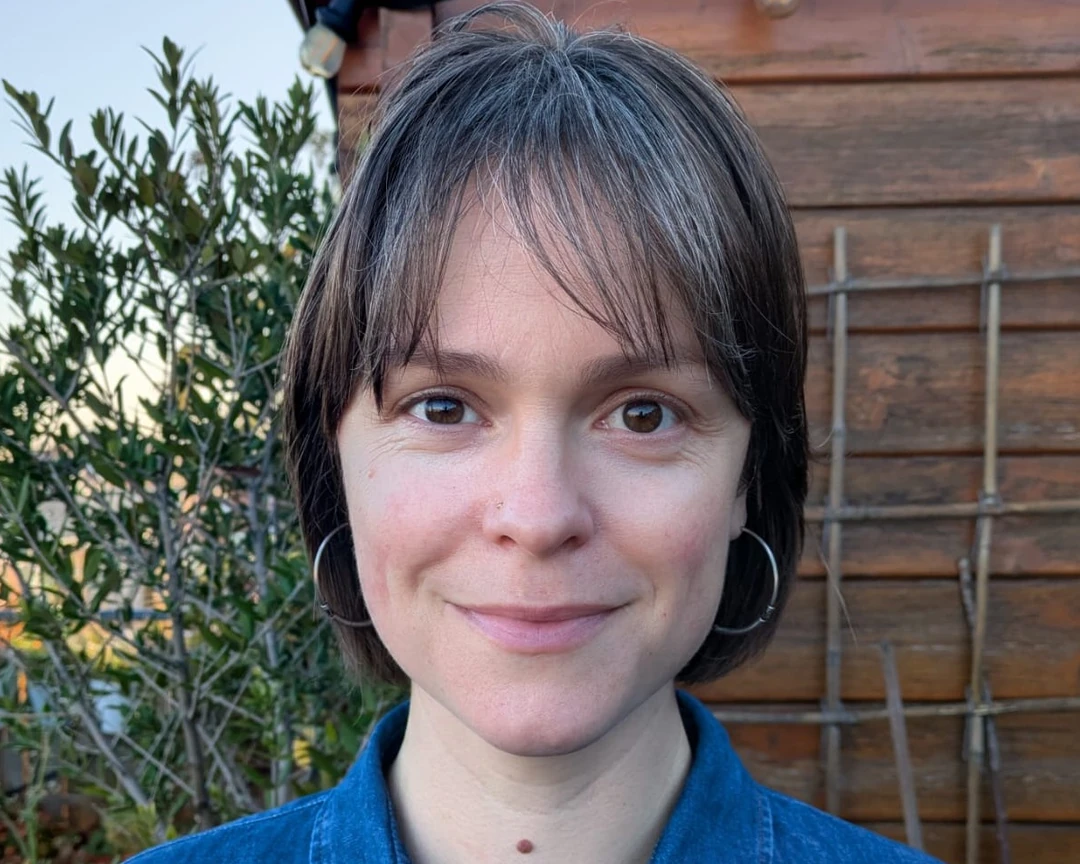
Dr Enid Still
BA Hons, Msc, MPhil, PhD
Postdoctoral Research Fellow
Livelihoods and Institutions Department



Dr Enid Still joined the University of Greenwich as a Postdoctoral Research Fellow in October 2026. She is part of the Livelihoods and Institutions Department at NRI and works with Dr Lora Forsythe on the UKRI funded research project: ‘Hitting the ground: an international arts-led transdisciplinary partnership to address GBV in food systems through a body/story/environment approach.’ In this role, she is supporting project partners to analyse and disseminate research results, with the aim to inform policy, research and practice agendas focusing on gender-based violence in food systems.
More generally, Dr Still works on the role of affect in changing agri-food systems and socio-ecological relations. Through a combination of ethnography, discourse analysis and archival research, she examines how affect entangles emotions, the body, memories, ethics and the more-than-human to shape contested sites of sustainability and development. She is also co-founder and co-lead of the Feminist Agroecology Network.
Before joining the University of Greenwich, Dr Still trained as an anthropologist at the University of Oxford (2015-16) and Savitribai Phule Pune University in India (2016-18). From 2018-2022 she was a Marie Sklodowksa-Curie Fellow as part of the Wellbeing, Ecology, Gender and cOmmunity (WEGO) Innovative Training Network (ITN). She then completed her PhD in Sociology at the University of Passau in 2025, with a specialisation in Feminist Political Ecology.
For her monograph titled: Affective Roots: Memory, Emotion and Viscerality within Organic Agri Food Networks in Tamil Nadu, India, Dr Still was awarded the Science Dissertation Prize 2025 from the Association of Friends and Sponsors of the University of Passau (Wissenschaftspreis der Universität Passau 2025 den Dissertationpreis des Vereins der Freunde und Förderer der Universität Passau e. V.). The manuscript will soon be published as a book by Bloomsbury Academic in their series: New Writing in Critical Development Studies.
As a feminist and interdisciplinary social scientist, Dr Still is interested in the role of affect in shaping socio-ecological relations in agri-food systems and contested sites of development. Through a feminist and ethnographic approach she explores ethical practice and sustainability discourse in food and agricultural development initiatives with the aim to unpack obscured power dynamics and histories that shape affective relationships with the more-than-human. Applying a feminist approach to contentious sites of development, enables an attentiveness to the ways intersectional power dynamics and affect co-constitute spatial, psychosocial, ecological and political relations.
Dr Still’s interest in affect began with anthropological studies of hope during her MSc and MPhil, with the latter focusing on the politics of hope among urban development practitioners in Pune, India. This interest was deepened during her PhD research, which explored the role of affective socio-ecological relations in processes of agricultural change in Tamil Nadu, India. Working with organic activists and farmers across different sites in Tamil Nadu, she found that memory, emotions and visceral experiences were politically salient in agrarian change.
Her research contributes to existing work in Feminist Political Ecology on the role of emotion in human-environment relations and highlights significant gaps in knowledge around the politics of affect in development spaces, relationships and studies.
For her monograph titled: Affective Roots: Memory, Emotion and Viscerality within Organic Agri Food Networks in Tamil Nadu, India, Dr Still was awarded the Science Dissertation Prize 2025 from the Association of Friends and Sponsors of the University of Passau (Wissenschaftspreis der Universität Passau 2025 den Dissertationpreis des Vereins der Freunde und Förderer der Universität Passau e. V.).
Dr Still is currently a member of:
- Marie Curie Alumni Association
- Entwicklungssoziologie und Sozialanthropologie (ESSA), Deutsche Gesellschaft für Soziologie (DGS)
- European Association of the Study of Science and Technology
Dr Still is the co-founder and co-lead of the Feminist Agroecology Network
- Tozzi, A. and Still, E. (2025) ‘The Ambiguous Ecologies of Agri‐Alternatives: Exploring the Calculus of Social Reproduction in Rural India’, Journal of Agrarian Change, p. e70048. Available at: https://doi.org/10.1111/joac.70048.
- Bourguignon, N. et al. (2023) ‘More-Than-Human Co-becomings: The Interdependencies of Water, Embodied Subjectivities and Ethics’, in W. Harcourt Agostino, A.,. Elmhirst, R.,. Gómez, M.,. Kotsila, P. (ed.) Contours of Feminist Political Ecology. Palgrave, pp. 129–153. Available at: DOI: 10.1007/978-3-031-20928-4_6.
- Padmanabhan, M. et al. (2022) ‘Principles of Critical Development Studies’, Asien, pp. 210-220 Seiten. Available at: https://doi.org/10.11588/ASIEN.2021.160/161.19214.
- Still, E. (2022) ‘Untangling Agricultural Ethics: Women’s Collective Agriculture in India as Alterbiopolitics’, Asien, pp. 17-42 Seiten. Available at: https://doi.org/10.11588/ASIEN.2021.160/161.20430.
- Millora, C., Maimunah, S. and Still, E. (2020) ‘Reflecting on the ethics of phd research in the global south: Reciprocity, reflexivity and situatedness’, Acta Academica, 52(1), pp. 10–30. Available at: https://doi.org/10.18820/24150479/aa52i1/SP2.