

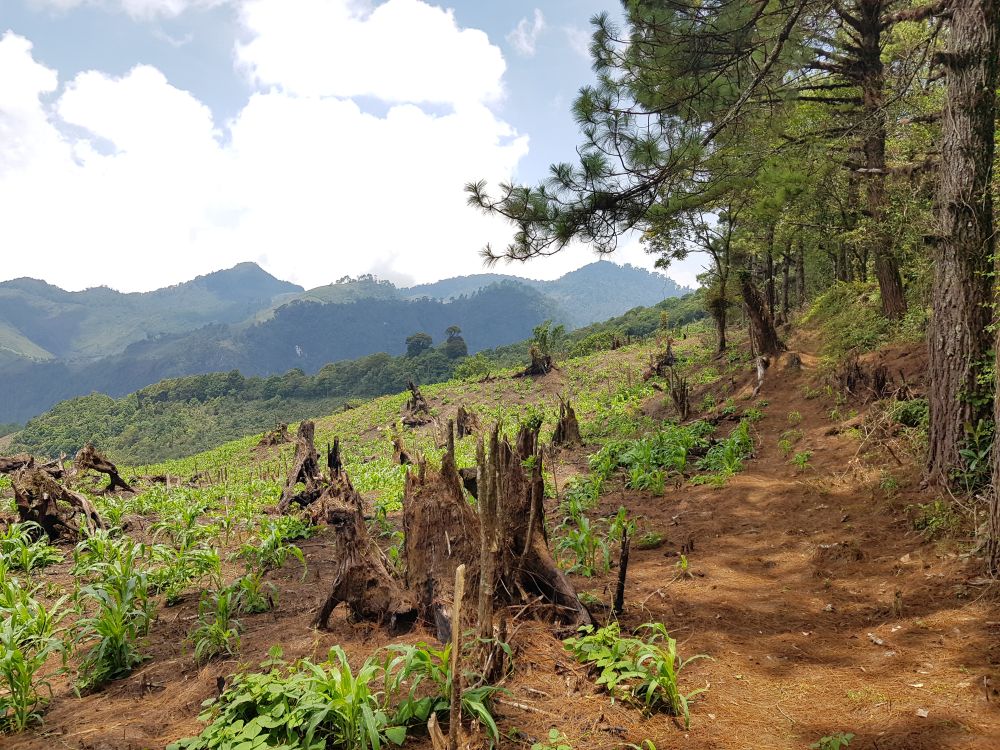
The Sierra Yalijux mountain range in central Guatemala is both a Key Biodiversity Area and home to the sacred hills of the Q’eqchi’ Indigenous People. However, the area is threatened by forest fragmentation and climate extremes, isolating highland endemic species and increasing environmental degradation.
In 2024–2025, a project led by NRI’s Professor Jeremy Haggar helped demonstrate the rich biodiversity value of the area, while also contributing to the establishment of a new biological corridor and supporting Q’eqchi’ communities to document their Indigenous knowledge of nature.
Working in collaboration with the Federation of Cooperatives of the Verapaces (FEDECOVERA) and the Association of Private Nature Reserves of Guatemala, the project monitored animal biodiversity in remnant forest fragments and agroforestry systems. This work confirmed the presence of four endemic frog species and three endemic salamanders listed on the International Union for Conservation of Nature (IUCN) Red List, including the critically endangered frog, Craugastor daryi. Crucially, these findings showed that even small forest fragments and sustainable agroforestry systems can play an important role in biodiversity conservation. Sightings of wild cats (Margay, Ocelot, and Jaguarundi) further underlined the ecological significance of the region.
The project also played a pivotal role in strengthening community-led conservation. When prolonged drought and forest fires struck the region in 2024, four cooperatives united to protect a forested ridge along their boundary. To reinforce this commitment, project partners are working with the communities to define two forest conservation areas under Cooperative Management Agreements with Guatemala’s Council for Protected Areas (CONAP). These agreements will safeguard sacred hills, such as Cerro Qwa Siyap and Cerro Don Juan, ensuring cultural and ecological values are simultaneously protected.
Professor Haggar said: ‘These local agreements and the formation of the broader biological corridor will be critical to communities accessing incentives for forest conservation and restoration and provide a more secure environment both for biodiversity and the Indigenous communities.’
Equally important was the development of instruments for protecting traditional knowledge, advancing community rights, and fostering more equitable, respectful engagement between Indigenous Peoples and external actors. With project support, ten Q’eqchi’ communities representing 4500 families documented their terms and conditions to regulate access to their knowledge and resources in Biocultural Protocols, approved by their cooperative assemblies. Dr Pamela Katic, Associate Professor in Economics at NRI, who also contributed to the project explained: ‘This work demonstrates how Indigenous communities can articulate governance norms rooted in their biocultural values and territorial rights.’
The project is further supporting 10 cooperatives affiliated to FEDECOVERA to reforest 440 hectares of land that had largely been converted into cardamom fields, the main source of income for the communities. This exercise will help convert these fields into agroforestry systems and enhance their conservation value.
To promote wider landscape conservation, the project convened a multi-institutional roundtable that brought together cooperatives, private nature reserves, and government agencies. This collaboration aimed to enable access to reforestation incentive payments, the Guatemalan Institute for Tourism which is providing training to communities interested in tourism, and the National Council for Protected Areas which helps update private nature reserve management plans and conservation agreements.
Importantly, the Ministry of Environment and Natural Resources has now selected the Sierra Yalijux for the development of a Biological Corridor, providing a permanent forum for joint action between FEDECOVERA, the Association of Private Nature Reserves and their members, and government institutions to sustain conservation in the region beyond the life of the project.
Through this work, NRI and project partners not only helped support biodiversity conservation but also to embed Indigenous knowledge and community stewardship at the heart of long-term conservation strategies in Guatemala.