

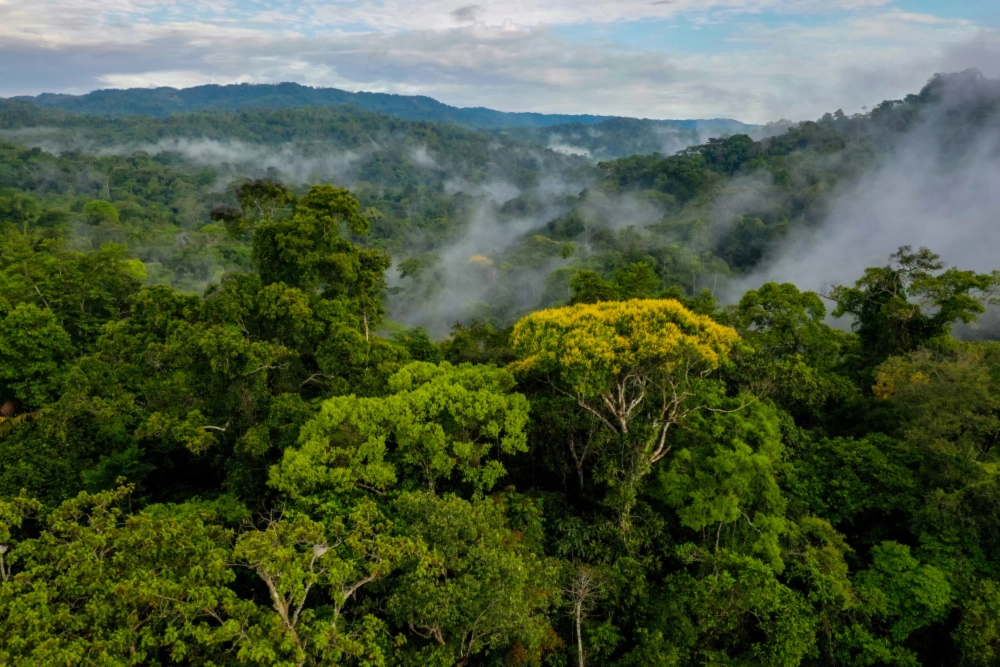
Forests are vital to life on Earth. They support ecosystems, store carbon, protect biodiversity, and provide livelihoods for millions of people worldwide. However, these critical environments are under increasing pressure from large-scale agriculture, mining, infrastructure expansion, and the growing global demand for commodities driven by unsustainable consumption. Understanding how to protect forests while supporting sustainable development is both urgent and necessary.
NRI researchers have been working with partners across the world to examine how conservation policies, community governance, economic development, and global supply chains interact to shape forest landscapes. This vital work provides evidence to guide policy decisions that benefit both forests and the communities that depend on them.
Conservation that benefits both forests and communities
Protected areas are a cornerstone of forest and biodiversity conservation, but their social impacts are rarely examined. Research involving NRI scientists analysed protected areas in 31,000 villages in western Indonesia and found that if well-managed, they can reduce deforestation while avoiding negative effects on local communities. In some cases, villages near protected areas also experienced improvements in health and living standards.
Dr Truly Santika, Associate Professor of Environmental Geography at NRI, said: ‘Forests are more than mere environmental assets. They are deeply tied to the livelihoods, cultures, and well-being of the people who depend on them. Our research shows that thoughtfully designed and inclusive conservation policies can support both healthy ecosystems and thriving communities, recognising them as interconnected rather than separate entities.’
Strengthening equitable community-led forest governance

In many countries, community forestry programmes grant local communities formal rights over forest management, creating opportunities to enhance livelihoods while fostering sustainable stewardship. Monitoring is a critical component of these programmes, enabling the assessment of their benefits for both forest and people. However, tools and expertise needed (the evidence ecosystem) to support such monitoring remain inadequate, not only in terms of how the evidence is generated and utilised, but also how the actors involved perceive, interpret and trust the evidence itself.
NRI researchers have highlighted the urgent need to address this issue. A new project led by Dr Santika examines the evidence ecosystem within Indonesia’s social forestry initiatives, programmes characterised by complex social, cultural, environmental, and economic objectives, multi-tier governance structures, and diverse community pressures. This project aims to strengthen inclusive, equitable, evidence-based forest management that is effective and responsive to local socio-environmental dynamics.
Economic pressures and trade-offs in forest landscapes
Economic development often exerts significant pressure on forest landscapes. Activities like mining and industrial-scale agriculture generate complex ecological and social impacts. Recent research by NRI and partners on nickel mining in Indonesia shows that while mining can deliver local economic benefits, such as infrastructure and job opportunities, it can also drive substantial forest loss and long-term environmental degradation that disproportionately affects local communities. Carefully understanding these trade-offs is essential for designing policies that balance economic growth with socio-ecological sustainability.
Forest loss stems from local and global pressures. A study on global supply chains highlights how surging demand for commodities like palm oil, cocoa, and coffee can accelerate deforestation across distant landscapes. Reducing these pressures requires coordinated action across producers, governments, companies and consumers, underpinned by multilevel governance that integrates sufficiency-oriented consumption with incentives for sustainable production.
Dr Santika added: ‘Forests are influenced by decisions at multiple levels, from local land management to global markets and governance. Understanding these interconnected dynamics is key to achieving sustainable development for all.’
Evidence for better forest futures
Taken together, this research illuminates the complex forces shaping forests today, revealing how forests and people are deeply interconnected, including in the hidden ways our consumption connects us to distant landscapes. Effective forest stewardship requires equitable conservation policies, inclusive community governance, socio-economic practices grounded in sufficiency and coordinated global cooperation. Such strategies not only sustain forests and the livelihoods of surrounding communities but also safeguard broader societies whose well-being ultimately depends on these ecosystems.
By combining rigorous quantitative and qualitative analyses with strong, context-rich partnerships in forest-dependent regions, NRI researchers are generating the evidence needed to guide forest policies that are both environmentally sustainable and socially equitable. Their work highlights an important message: protecting forests is not just an ecological necessity but also the foundation for resilient communities and inclusive long-term development. Importantly, it helps safeguard the vital socio-ecological, cultural, and economic benefits that forests provide across generations and regions.