

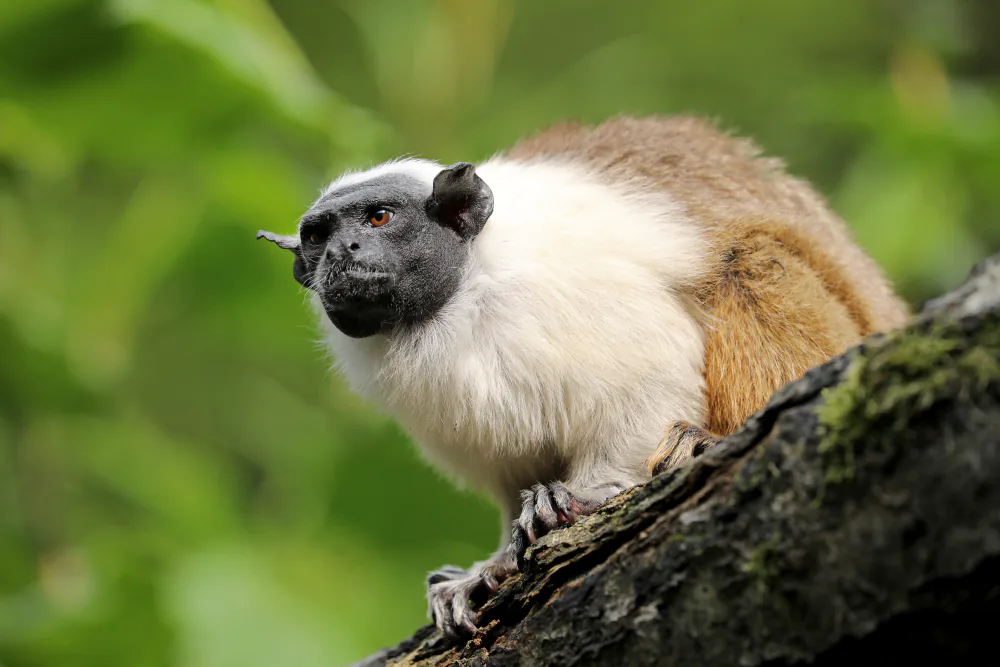
A new study published in the journal Urban Ecology reveals how the endangered pied tamarin (Saguinus bicolor) has adapted its behaviour to survive in the heart of Manaus, the Amazon’s largest city.
Weighing less than 500g and measuring under 30cm in length, the squirrel-sized monkey now lives in a landscape dominated by traffic, human activity and fragmented forest. Yet rather than retreating from urban noise, it has developed a nuanced strategy for coping with it.
The pied tamarin has a tiny natural range now largely occupied by Manaus. Because the species naturally favours disturbed forest – such as areas affected by tree falls and landslips – it has proved unusually capable of exploiting urban forest fragments, parks and even back gardens.
For more than 20 years, a team of biologists based at the Federal University of Amazonas (UFAM) has studied how this micro-monkey persists in a rapidly expanding city.
Over the past five years, Dr Tainara Sobroza, a UFAM primatologist (a scientist who studies primates such as monkeys and chimpanzees) and NRI researcher Dr Adrian Barnett have been studying the effects of urban noise on how the tamarins communicate and use the forest.
Their latest paper shows that the tamarins do not simply avoid noisy areas. Instead, their response depends on both food availability and territorial risk.
When fruit is abundant, groups spend more time in the quieter parts of their territories. However, when moving through noisier areas – particularly near territorial borders – they travel more quickly.
The researchers suggest that higher noise levels near territory borders increase the risk of missing important vocal signals, such as territorial challenges from neighbouring groups or distress calls from lost individuals. Moving quickly through these areas may reduce that risk.
It is exactly these behavioural subtleties that appear to have enabled the species to persist in an urban landscape where most other regional primates have retreated.
Dr Barnett said: ‘We expected tamarins to react to urban noise but were surprised by how combinations of factors influenced their behaviour. For example, retreating to quieter areas of their home ranges only when food is abundant or fleeing from noise only near the edges of their territorial borders, where competition with other groups is high. This shows how complex nature is, even in urban environments. So, conservation efforts must consider the system as a whole.’
This research has important implications. Manaus’ remaining forest fragments are surrounded by traffic-heavy roads and dense urban development. At the same time, there are plans to restore green corridors linking isolated patches of forest.
Understanding how pied tamarins navigate noisy urban environments will help ensure that these re-greening efforts support movement between populations while minimising unintended disturbance. This will allow the otherwise isolated populations of tamarins (and other forest-dwelling animals) to meet and mix, so reducing inbreeding.
Dr Sobroza said: ‘These results reinforce the importance of maintaining enriched environments for animals, for example, through planting fruit-bearing plants. By planting fruit trees and improving habitat connectivity, we can ensure the long-term survival of the species, and its well-being, since individuals will have the opportunity to select the most suitable areas within their home ranges – those that provide food as well as acoustic comfort.
While researchers have widely studied how urban noise disrupts species such as birds, the impact on social animals like primates remains largely underexplored. This study bridges this gap, providing a framework for protecting these animals in increasingly loud urban environments.
‘This study may serve as a model for what could happen to other primate species and how these effects can be mitigated in urban landscapes that support these animals,' Dr Sobroza noted.