

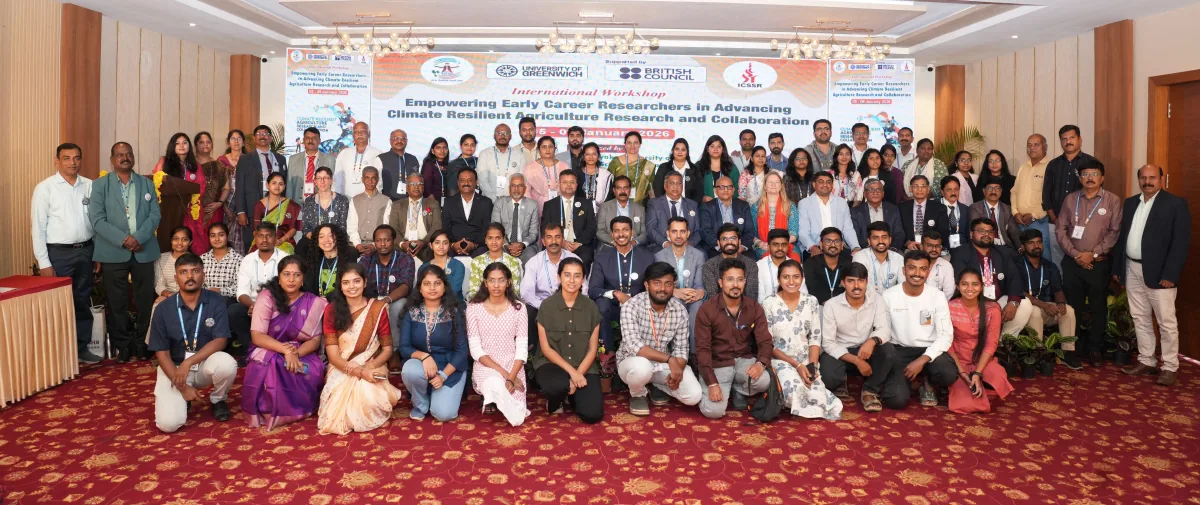
NRI, in collaboration with the Keladi Shivappa Nayaka University of Agricultural and Horticultural Sciences, Shivamogga (KSNAUHS), successfully delivered an international workshop dedicated to empowering early career researchers (ECRs) working on climate-resilient agriculture. Held in Shivamogga, Karnataka, India, from 5–9 January, the workshop brought together emerging researchers from India and the UK for an intensive week of training, exchange and collaboration.
The workshop was part of a project funded by the British Council ISPF, on Empowering Early Career Researchers in Advancing Climate-Resilient Agriculture Research and Collaboration (CRARC), launched in April 2025 and co-led by NRI and KSNUAHS. The project aims to strengthen ECR capacity through hands-on skills development, knowledge sharing and the establishment of long-term international research partnerships.
Building skills, confidence and networks
Over 40 participants attended the workshop, representing a wide range of institutions across India. The cohort reflected the project’s commitment to inclusivity, with ECRs drawn from multiple Indian states and balanced participation between female and male researchers. Seven participants from NRI joined the workshop, including two ECRs and three PhD students.
Designed specifically to support ECRs in India, the programme combined practical training with structured networking opportunities. Participants engaged enthusiastically throughout the week, contributing actively to discussions, group exercises and proposal-development sessions. Feedback from attendees, gathered via a post-attendance online survey, was extremely positive.
‘During this workshop, I learned the importance of a multidisciplinary approach and the value of collaboration across fields. I also gained insights on how to identify and pursue fundable research ideas effectively, integrating knowledge from various domains to create meaningful and impactful outcomes,’ said one of the participants.
From funding to field experience
The workshop programme covered the full research lifecycle, from identifying fundable research questions to building competitive proposals. Sessions included presentations from funding agencies on research funding opportunities in India and internationally, alongside talks on priority and emerging topics in climate change research.
Participants also took part in sessions on writing successful grant applications, exploring funding landscapes, and conducting systematic literature reviews and meta-analyses. These were complemented by interactive networking and proposal discussion exercises, enabling ECRs to test ideas and receive peer and expert feedback.
Learning extended beyond the conference hall through a dedicated field day at KSNAUHS facilities. Participants visited the university’s honey bee park, gene bank, insect museum and cashew processing unit, gaining first-hand insight into applied agricultural research. A visit to the Sakrebyle Elephant Camp provided a powerful lens on agroforestry and human–wildlife conflict, while a trip to a large-scale farm demonstrated innovative agricultural concepts in real-world practice.
Showcasing cutting-edge climate research
Expert presentations showcased the breadth of contemporary climate change research, with topics ranging from leveraging artificial intelligence for global sustainability, to water-sensitive agriculture, agricultural carbon credit initiatives in India, and the use of drones in farming. Additional sessions explored recent advances in plant pathology, soil science, breeding research and social science perspectives on climate change.
These expert insights were complemented by short poster presentations from all participants on the fourth day. Their concise overviews highlighted the depth and diversity of climate-related research and sparked discussions about future collaboration and joint funding opportunities.
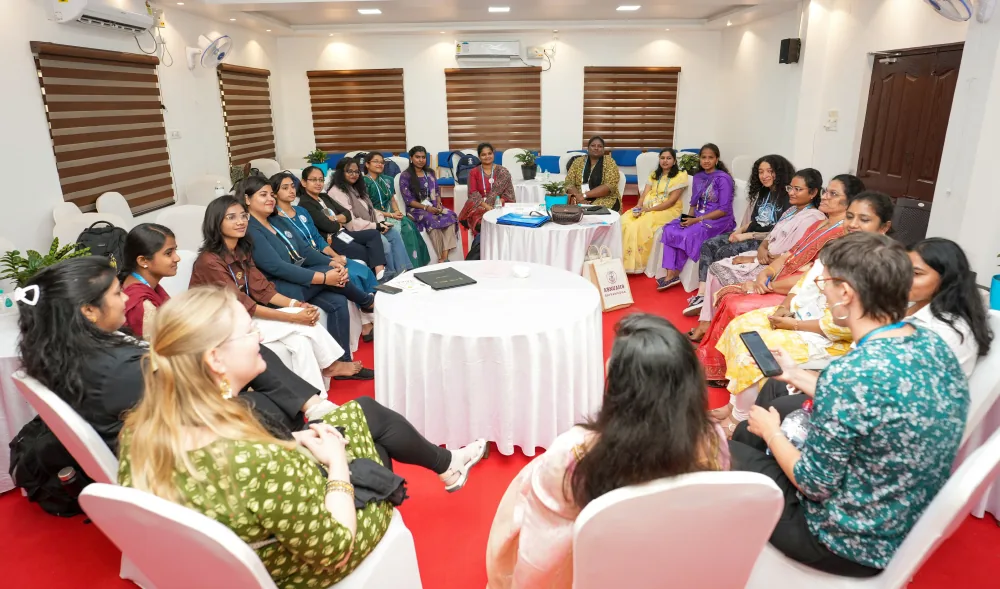
A dedicated session for female ECRs was also included to discuss barriers to career progression and strategies for overcoming them, reinforcing the project’s commitment to equity and inclusive research environments.
‘I deeply valued the bespoke session for women researchers, which provided a meaningful space to share experiences and build a strong sense of solidarity,’ one of the ECRs said.
Laying the foundations for long-term collaboration
This project was designed to support impactful, community-engaged research addressing urgent global challenges in food systems, sustainability and climate adaptation. Reflecting on the workshop, project coordinator, NRI’s Dr Karna Hansson emphasised its longer-term significance: ‘There have been many interesting discussions. Hopefully this week has formed long-lasting connections, leading to more collaborations in the months and years to come.’
Project Lead and Associate Professor in Crop Ecology at NRI, Dr Lucie Büchi added: ‘We look forward to building on this workshop to establish long-lasting collaborations with staff and students at KSNAUHS.’
Dr Vinaya Kumar, Assistant Professor at KSNAUHS, said: ‘Beyond the academic outcomes, this experience strengthened professional connections, encouraged collaboration and reinforced the value of collective effort in advancing climate-resilient agriculture research.’
This project was funded through the British Council’s International Science Partnerships Fund and the Indian Council for Social Science Research.