

Food systems sit at the centre of many of the challenges facing the world today. These interconnected challenges, including climate change, biodiversity loss, malnutrition, inequality, wars and supply chain disruptions, have also exposed the weaknesses in our food systems. They have also highlighted why increasing food production and productivity will not be enough to guarantee food security.
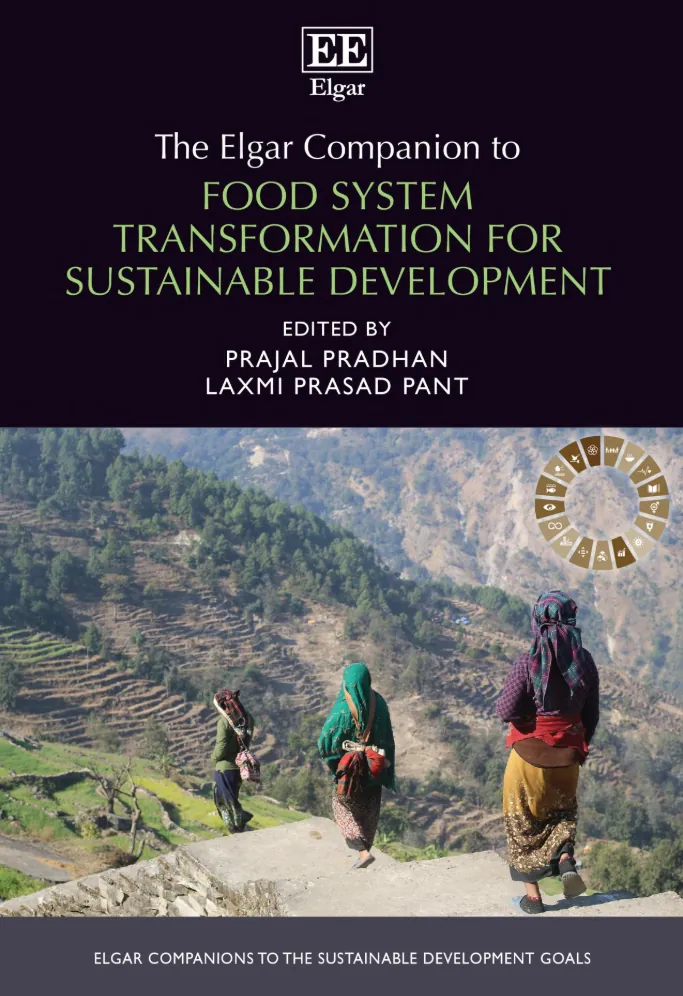
A new book edited by NRI’s Dr Laxmi Pant and Prajal Pradhan (University of Groningen) provides an extensive, interdisciplinary analysis of food system transformation and how it impacts the Sustainable Development Goals (SDGs).
The Elgar Companion to Food System Transformation for Sustainable Development (Edward Elgar Publishing, 2026) brings together 26 chapters from 65 researchers and practitioners working across different disciplines and regions worldwide. The book places food systems at the heart of the sustainable development agenda, linking them to issues including poverty, climate action, governance, conflicts and wars, and gender equality.
Food justice, equity and health
Some of the volume’s standout contributions are on gender, education, labour and justice. These chapters challenge technology-first narratives of food system transformation, stressing that sustainability is impossible without confronting systemic inequalities, including knowledge hierarchies among disciplines and epistemic traditions. These contributions also broaden the debate beyond technocratic and environmental considerations through a compelling critique of colonial approaches to food system and sustainability education.
Other chapters examine links between food systems and social inclusion, underlining the importance of viewing food systems as food production mechanisms but also crucially as determinants of livelihoods, public and planetary health and social justice. Discussions on malnutrition and dietary health shift the focus from food availability to emphasise food access, dietary quality and wellbeing, aligning with growing scientific consensus on the importance of food systems to economy, society and the environment.
Dr Pant said: ‘The SDGs gave us a common vocabulary and a set of shared targets, but these goals remain sectoral. Zero Hunger, for instance, ends up as the business of those in food and agriculture while decisions about food production and processing, trade, public and planetary health, and energy require much broader collaboration. We began the Companion by asking how Zero Hunger connects to the other goals. From there we asked the harder questions about who governs food systems, on whose terms, and why well-intentioned interventions fail to deliver transformative change when they meet the realities of land, labour, power and profit.’
Environmental resilience and ‘nexus thinking’

Environmental sustainability and climate resilience are another cornerstone of the book. Chapters covering agricultural frontiers, supply-chain vulnerabilities, aquatic foods, and climate-smart agriculture highlight the increasingly complex linkages between food systems and ecosystems. The volume makes an important contribution through its focus on ‘nexus thinking’, acknowledging the interdependencies between food, water, energy, and climate systems.
Urban food systems governance
The book also directs necessary attention to urban food systems and governance. Examining real-world examples, such as sustainable food provisioning and food governance in Berlin, the text highlights how cities are emerging as key centres of food system transformation. These case studies show that food systems are profoundly political, involving competing priorities and complex governance challenges.
Global scope and interdisciplinarity
The volume’s policy relevance is further enhanced by its global scope and its tackling of food insecurity, hunger and malnutrition from interdisciplinary and sectoral orientations. Case studies from South Asia, Africa, Latin America, Europe, North America, and Australia make it a key resource for comparing food systems across different contexts. Importantly, the case studies also highlight that approaches to food system transformation must be situated and context specific.
Dr Pant said: ‘As the saying goes, societies have problems, universities have disciplines and departments. No single discipline or department is enough for something as tangled as a food system. This Companion brings researchers from different fields, including agronomists, geographers, climate scientists, dietitians and political ecologists, around the same question about how Zero Hunger connects to the other goals. More food in one place can mean less fresh water, more pollution or unfair labour practices somewhere else. Our message is that transforming food systems is neither a technical fix nor the work of a single discipline. It is a question of who governs them, and in whose interest.”
A timely resource
The Elgar Companion to Food System Transformation for Sustainable Development offers a comprehensive critical analysis of modern food systems. It is a timely and valuable resource for students, educators, researchers, policymakers and practitioners navigating the complexities of food system transformation.
The full volume and eBook are available here: The Elgar Companion to Food System Transformation for Sustainable Development