

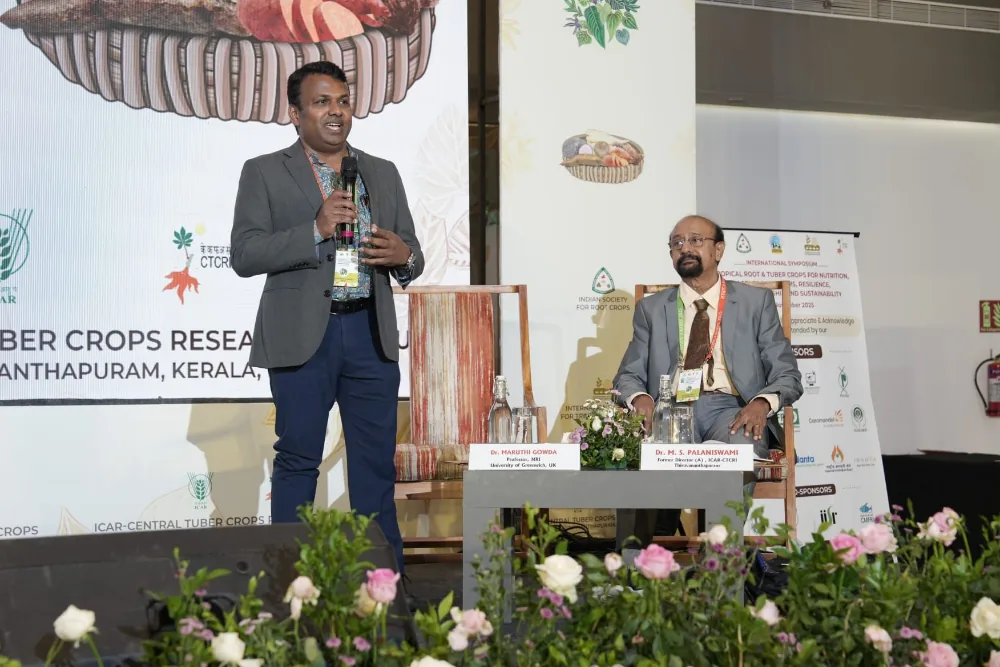
NRI’s Professor Maruthi Gowda has been appointed to the prestigious role of President of the International Society for Tropical Root Crops (ISTRC), a global scientific society dedicated to advancing research and innovation in tropical root and tuber crops. Established in 1967, ISTRC is a global network of over 300 members from more than 60 countries.
The appointment was announced during the International Symposium on Tropical Root & Tuber Crops for Nutrition, Agrifood Systems, Resilience, Entrepreneurship and Sustainability (ISTRTC 4 NARES), held in Kerala, India, from 17–21 November 2025.
Professor Gowda will lead ISTRC from November 21, 2025, for a six year term, with the position set to be renewed at the 2031 ISTRC international symposium.
Advancing root and tuber crop food systems
ISTRC plays a critical role in promoting research on crops such as cassava, yams, sweetpotato, taro and other tropical tubers, crops that are central to food security, nutrition and livelihoods for millions of smallholder farmers across low- and middle-income countries.
Reflecting on his appointment, Professor Gowda emphasised the growing importance of tropical root crops in the face of global challenges such as climate change and food insecurity.
Under Professor Gowda’s leadership, the Society will focus on elevating the global profile of tropical root crops as climate-smart staples that underpin food security. It will strengthen interdisciplinary research that brings together genetics, agronomy, nutrition, value-chain development and policy. The Society will also accelerate innovation and technology transfer to ensure research moves beyond laboratories and reaches fields, processing centres and markets.
Further priorities include building inclusive partnerships with academic institutions and other stakeholders, investing in capacity building—particularly in low- and middle-income regions—and nurturing the next generation of root-crop scientists and entrepreneurs. In addition, the Society will advocate for greater funding and policy attention, so tropical root crops receive the recognition in global agricultural agendas and the investment they deserve. These aims will be pursued through collaboration with the Society’s councillors and members, and primarily through the organisation of its triennial conference.
Global leadership and recognition
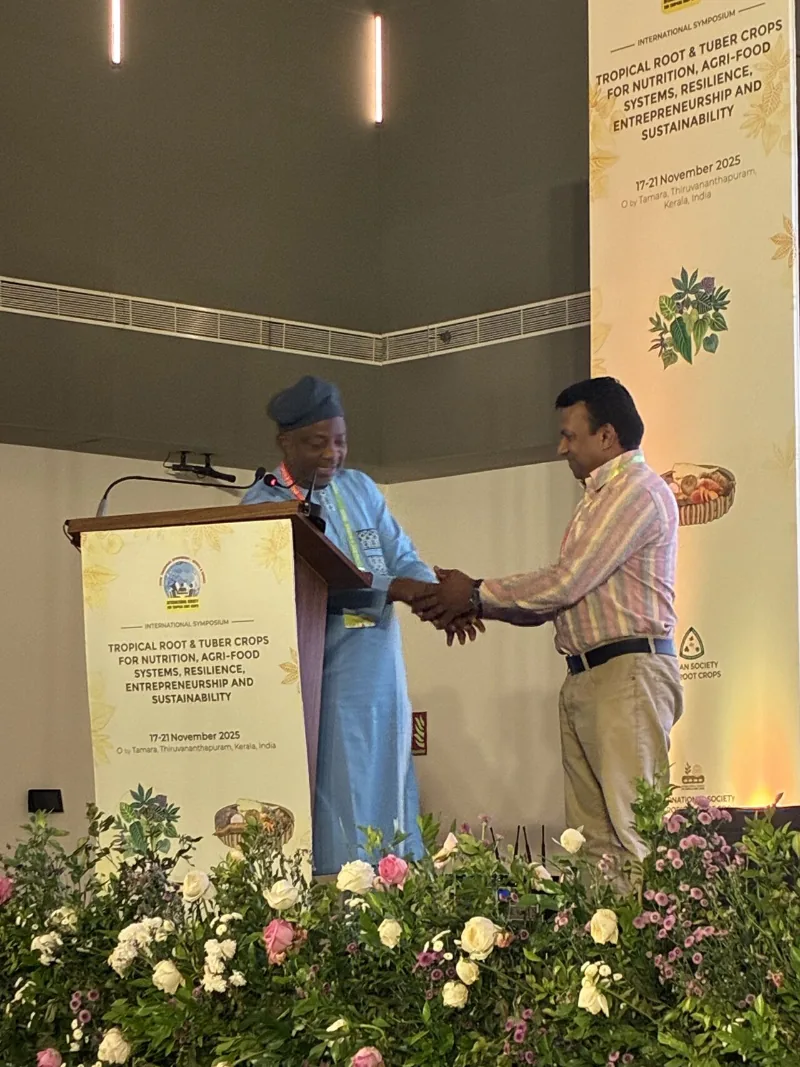
Professor Gowda’s appointment reflects his international contributions to tropical root and tuber crops research and capacity building. His presidency highlights the role of NRI researchers in shaping and contributing to influential global networks.
Former ISTRC president, Professor Lateef Sanni, said: It has been a profound honour to serve the ISTRC, and I am delighted to see the presidency transition to Professor Gowda. Having worked closely with him, I have seen firsthand his dedication to elevating 'orphan crops' like cassava and yam into the global spotlight. As we face increasing climate volatility, his vision for interdisciplinary research and laboratory-to-field innovation will be essential to support the millions of smallholder farmers who depend on these staples. I am confident that under his leadership, the Society will continue to thrive and expand its impact.
Professor Gowda succeeds outgoing President Professor Lateef Sanni. He acknowledged the contributions of previous ISTRC presidents, councillors and advisors who have helped shape the Society’s direction and impact.
About the ISTRC
The International Society for Tropical Root Crops (ISTRC) was established in 1967 to foster, stimulate and support activities and initiatives leading to the improvement of tropical root crop production and utilisation.
Through its international networks, ISTRC convenes triennial symposia, supports collaborative research and promotes scientific excellence and practical innovation to ensure tropical root crops receive the recognition, investment and policy attention they deserve on global agricultural agendas.
The next ISTRC triennial symposium will be held in Trinidad and Tobago in November 2028, and Prof. Gowda encourages the global root and tuber crop community to plan to participate widely.