

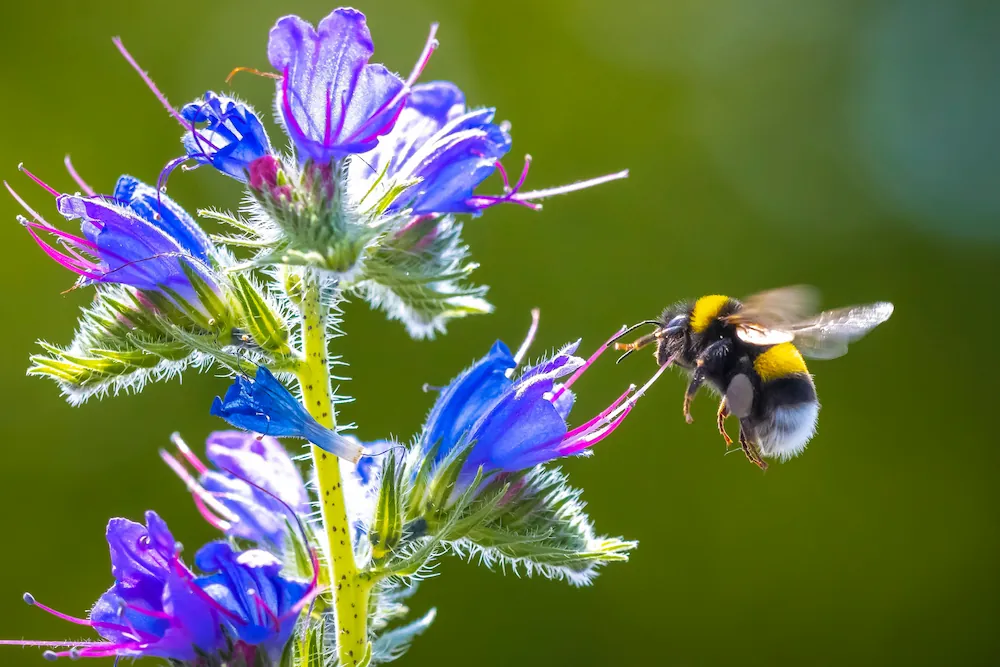
Pollinators are critical ecosystem service providers supporting plant reproduction in natural ecosystems and contributing to food production. For example, 90% of flowering plants and 75% of food crops benefit from pollination services. Some crops, including strawberries and tomatoes, are highly dependent on pollinators but are typically grown under protected and controlled environments (PACE), so typically require pollination services from managed or commercial bees.
Understanding how natural processes such as diseases and nutrition influence the health of pollinators is critical to maintaining these pollination services – especially for global food security and in light of global changes. NRI scientists led by Professor Phil Stevenson have been studying the interactions between pollinators and flowers for many years and are using some of these findings to optimise the pollination service of commercial bumble bees in fruit and vegetables in the UK.
In 2013, along with scientists at Newcastle University – notably Professor Geraldine Wright – NRI researchers discovered that the nectar of Citrus and Coffee contained caffeine at concentrations that enhanced honeybee memory for floral odours associated with good food. Further studies showed that this influenced the behaviour of foraging bees and colonies towards a caffeinated food store, suggesting that honeybees were being ‘drugged’ by the plants to better recall and return to them and so improve pollination.
In PACE crops, bumble bees are the preferred pollinators for strawberries, although honeybees may also be used. Tomatoes rely heavily on bumble bees because they require a specific type of pollination called buzz pollination, which only bumble bees can provide. 'Our research thus focuses on bumble bees due to their importance in pollination. However, their services are notoriously unreliable. We are therefore exploring how to optimise their behaviour to boost pollination and crop yields', Professor Stevenson said.
Working with NIAB and Berry Gardens (a fruit growing company) in 2017, NRI scientists investigated whether they could prime or train commercial bumble bees with caffeine to improve their ability to locate and target strawberry crop flowers and improve yields. In the lab, they showed for the first time that bees could be ‘trained’ to locate a food source more effectively if it had been primed using caffeine and the target odour. Under greenhouse conditions, the effect was more nuanced. However, earlier studies suggested that fruit quality could be improved with bees primed with caffeine.
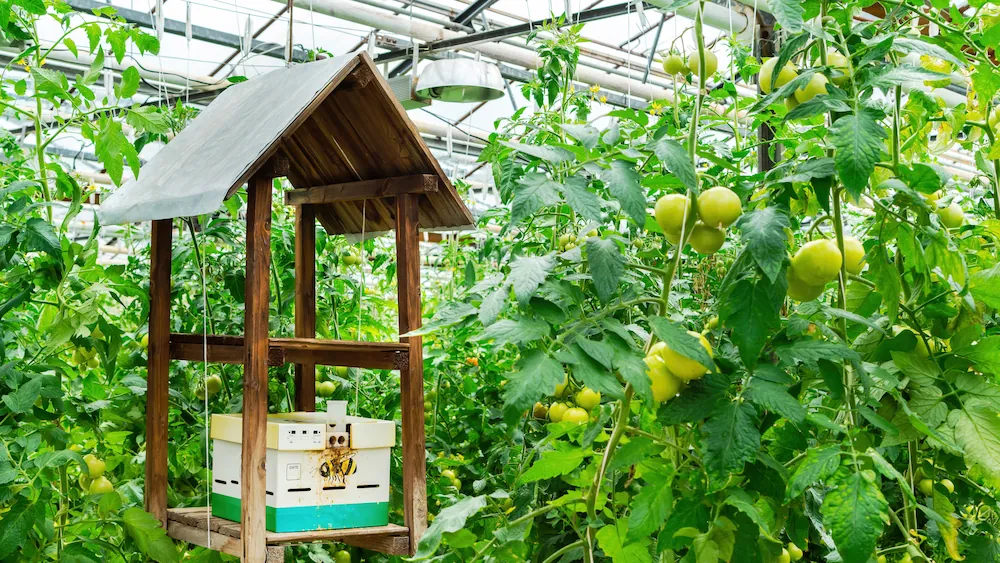
Building on this, the researchers are working with Oxford University to improve pollination by bumble bees in tomatoes. Greenhouse-grown tomatoes require active pollen transfer, either through mechanical means or by foraging bees such as the domesticated bumblebee, Bombus terrestris. In greenhouses, tomatoes pollinated by bumblebees have larger fruit and greater yield per hectare than those pollinated mechanically but using bumblebees has some drawbacks. Growers are limited to using UK native subspecies of the buff-tailed bumblebee, B. terrestris audax, to prevent the spread of disease to wild bumblebees. However, these colonies generally decline within 2-4 weeks of placement and exhibit relatively poor pollination rates on soft fruit and vegetable crops including commercially valuable tomato varieties. The reasons for their poor performance are unknown. Currently, growers place colonies in glasshouses without any direct monitoring. Except for counting bitemarks left by visiting bees on flowers, they also have no way to relate bee behaviour to actual pollination rate and yield of tomatoes. The researchers have proposed developing methods to monitor and improve the management of B. terrestris audax on UK-grown tomatoes in collaboration with Thanet Earth (Kent), the UK's biggest glasshouse tomato grower, and sensor-based bee technology company, Bee-Ops.
This project will employ the latest sensor technology to monitor the activity and efficiency of B. terrestris audax colonies in commercial glasshouses at Thanet Earth. Sensor technology will enable the project team to provide growers with important data about the current state of pollination. This will include a rating of the quality of the colonies received from their preferred suppliers and high-resolution information about floral visitation and foraging rate of colonies for specific varieties and its influence on yields under particular conditions (e.g. time of year, temperature).
They will also comprehensively test how the developmental phase of colonies introduced to glasshouses influence foraging rate. Using an optimised pollen substitute for bumblebees developed by Oxford and NRI, they aim to improve colony longevity by studying how nutritional intervention early in colony development affects the colony's population size and foraging rate.
Further, they will measure the volatile compounds emitted by tomato floral odours. Using methods developed at NRI, they will train bees to orient towards tomato floral scents by exposing bees in colonies to tomato floral scent in association with caffeinated nectar. These data will form the basis of a strategy for improved colony management by showing how specific interventions improve the pollination efficiency of bumblebees on specific tomato varietals. The researchers predict that the combination of methods developed through this project will generalise to bumblebee pollination of other fruit and vegetable crops grown in greenhouses or polytunnels.