

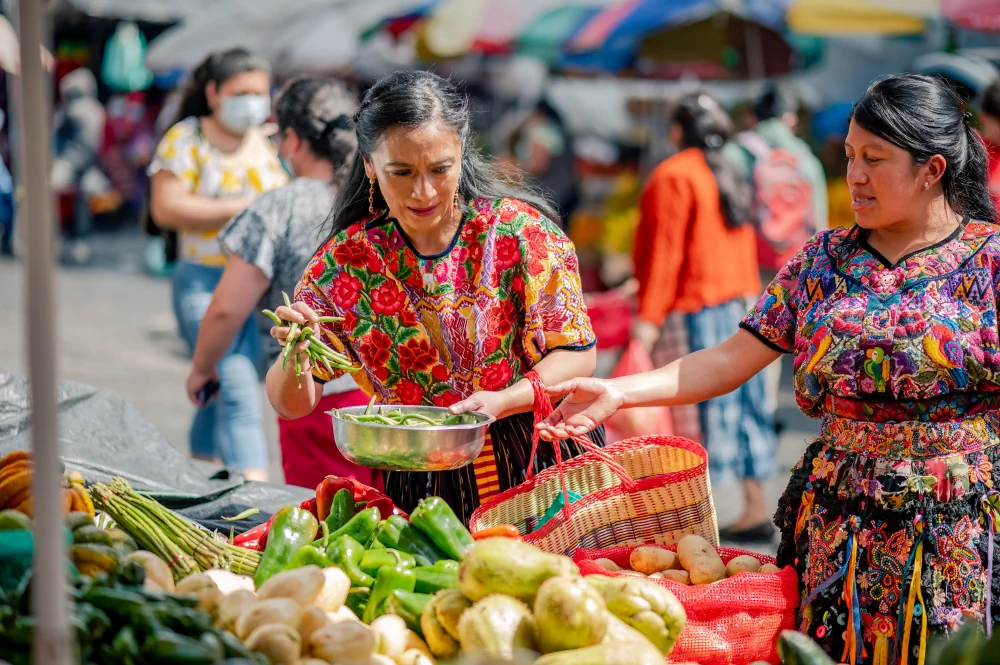
Cast your mind back over all the places where you have acquired and consumed food this week. How about the past month or year? The supermarket, the takeaway, that café where you grab coffee and a bite whilst on the go, the delivery app on your phone, or perhaps a nearby garden, greenspace or leisure setting? Think about that recent meal you shared with family or friends, and the last time you asked, ‘what’s for dinner?’ This is your food environment.
Food environments are central to our world around us. In the abstract sense, they have been described as the ‘shop window’ of the food system. However, food environments are more than simply the backdrop to our daily lives. They are relational. Just like catching a glimpse of your reflection in that ‘shop window’, the foods we acquire and consume reflect our personal circumstances and more broadly, our lived experience of the food environment. Two people can live in the same neighbourhood, on the same street, and even under the same roof, yet have a very different lived experience of their food environment when they leave their front door.
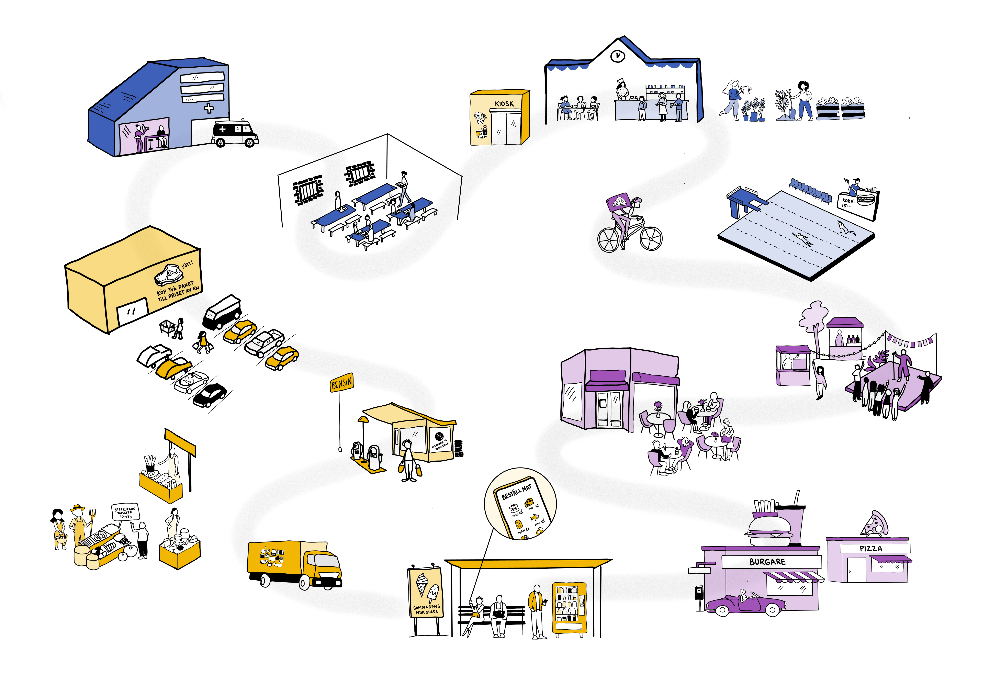
Food environment research has gained momentum over the past two decades as researchers, policymakers and practitioners have sought to address mounting public health nutrition-related challenges around the world. Today, food environments are considered to be a key interface within the wider food system where people acquire and consume foods. This interface forms the central tenet of the Turner et al. (2025) conceptual framework for food environment research, policy and practice – developed by the Agriculture, Nutrition and Health Academy Food Environment Working Group (ANH-FEWG) (Figure 2).
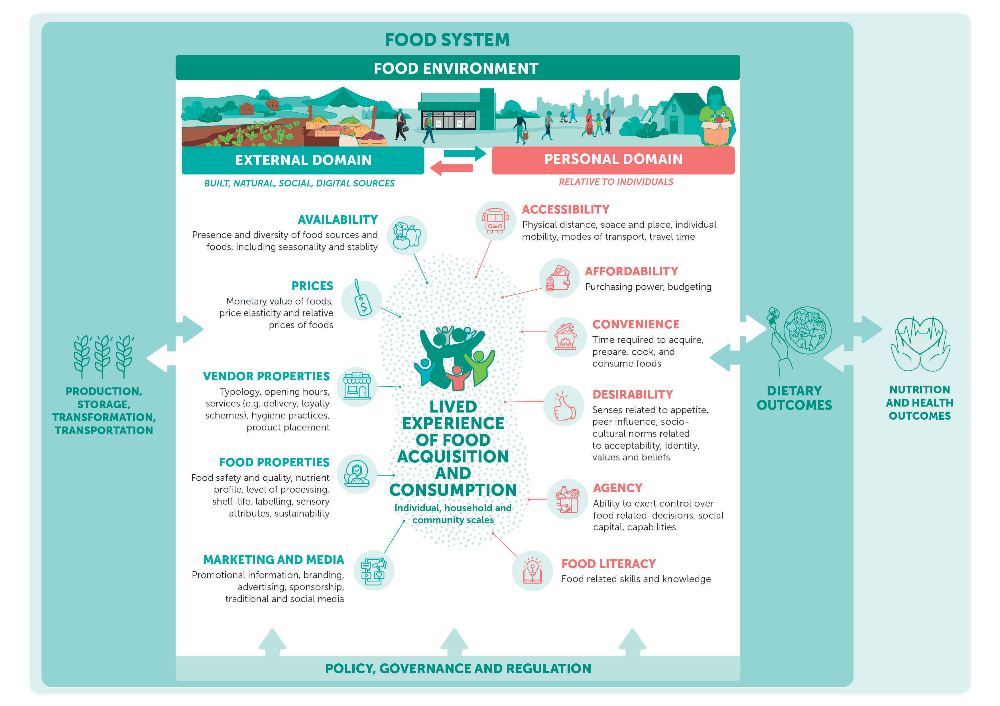
Text description of the food system diagram
The food environment sits within the wider food system. It brings together external conditions and personal circumstances that shape people's experiences of obtaining and consuming food, at individual, household and community levels. The external and personal domains interact with each other.
External domain
This covers built, natural, social and digital sources of food and food-related information. It includes:
- Availability: the presence and diversity of food sources and foods, including seasonality and stability.
- Prices: the monetary value and relative prices of foods, and how demand responds to price changes.
- Vendor properties: types of food vendor, opening hours, services such as delivery and loyalty schemes, hygiene practices and product placement.
- Food properties: food safety and quality, nutrient content, level of processing, shelf life, labelling, sensory attributes and sustainability.
- Marketing and media: promotional information, branding, advertising, sponsorship, and traditional and social media.
Personal domain
This covers factors relative to each individual. It includes:
- Accessibility: physical distance, space and place, individual mobility, available transport and travel time.
- Affordability: purchasing power and budgeting.
- Convenience: the time required to obtain, prepare, cook and consume food.
- Desirability: appetite and sensory preferences, peer influence, and social and cultural norms relating to acceptability, identity, values and beliefs.
- Agency: the ability to control food-related decisions, social connections and resources, and capabilities.
- Food literacy: food-related skills and knowledge.
Connections within the wider food system
At the centre of the diagram is the lived experience of food acquisition and consumption, connected to the factors in both domains.
Two-way arrows connect food production, storage, transformation and transportation with the food environment. Further two-way arrows connect the food environment with dietary outcomes, and dietary outcomes with nutrition and health outcomes. These indicate interactions and feedback rather than a purely one-way sequence.
Policy, governance and regulation sit beneath the food environment, with arrows pointing upwards to show their influence across it.
The interface features two domains. On the left, the external domain features five dimensions: food availability, prices, vendor properties, food properties, and marketing and media. This is the world that is ‘out there’ that we interact with (i.e. the ‘shop window’). To the right, the personal domain includes dimensions of food accessibility, affordability, convenience, desirability, agency and food literacy. The personal domain is relative to individuals – a reflection of self and personal circumstance.
At the heart of the framework, the ‘lived experience of food acquisition and consumption’ represents the embodied interactions that take place between people and their environment as they acquire and consume foods as part of their daily lives and activities. Importantly, this lived experience can be considered at the individual, household, and community scales.
Policy, governance and regulation underpin the interface, demonstrating how they create the foundational conditions and opportunities – as well as barriers and constraints in the food environment. By identifying levers for change, researchers, policymakers, practitioners and communities have the potential to shape food environments to improve public health nutrition. Fiscal, environmental, informational, and educational mechanisms provide promising intervention opportunities (Figure 3) and the potential for package deals. While not quite a ‘Buy One Get One Free’ deal, comprehensive bundles of policy actions targeting external and personal food environment domains have the potential to be mutually reinforcing. Further, they may serve as double-duty actions, simultaneously tackling both undernutrition and problems of overweight, obesity, and diet-related non-communicable diseases.
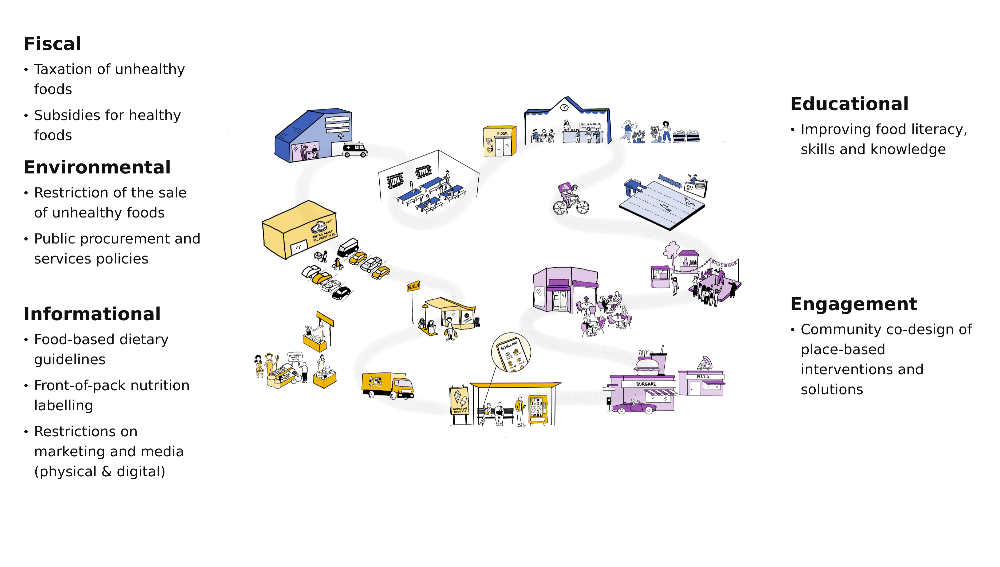
Read the text equivalent of this figure
A food environment illustration shows shops, markets, places serving food, delivery and community settings along a winding road. Five categories of policy intervention surround it; no arrows link individual interventions to specific settings.
Fiscal
- Taxation of unhealthy foods
- Subsidies for healthy foods
Environmental
- Restriction of the sale of unhealthy foods
- Public procurement and services policies
Informational
- Food-based dietary guidelines
- Front-of-pack nutrition labelling
- Restrictions on marketing and media (physical and digital)
Educational
- Improving food literacy, skills and knowledge
Engagement
- Community co-design of place-based interventions and solutions
In the spirit of innovating today to nourish tomorrow, and returning to the ‘shop window’ metaphor, food environments provide a unique opportunity for the kinds of innovative interventions needed today. Designing, styling and reorganising what is on display – and to whom – can help ensure that healthier foods become the affordable, desirable and convenient choice when the inevitable question of “what’s for dinner?” is posed tomorrow.