

One Health is an approach that recognises that human, animal and environmental health are inseparable. It aims to encourage policies and practices that improve collaboration across sectors in order to prevent disease, ensure food safety, and promote sustainable ecosystems and overall well-being. Despite their massive presence and influence, rodents are rarely treated as organisms linking these domains.
A new study by NRI’s Professor Steven Belmain argues that treating rodents as focal organisms - rather than peripheral risk factors - is key to reducing zoonotic threats, enhancing food security and supporting biodiversity.
Drawing on more than two decades of multidisciplinary research, largely from sub-Saharan Africa, Professor Belmain explains how rodents act as an integrative link between humans, animals and ecosystems, making them a fundamental part of One Health frameworks.
Ecosystem service providers and disease reservoirs
The review highlights that rodents are the most species-rich group of mammals, comprising approximately 43% of all mammals on Earth. Because of this immense diversity, rodents play key roles in their environments, some beneficial and others harmful.
On one hand, rodents provide key ecosystem services that influence biodiversity, nutrient cycling, and overall landscape structures. They can also be sensitive indicators of ecosystem health through monitoring their presence, absence or physical condition, providing insights on changes in pollution, ecosystem degradation or development of antimicrobial resistance.
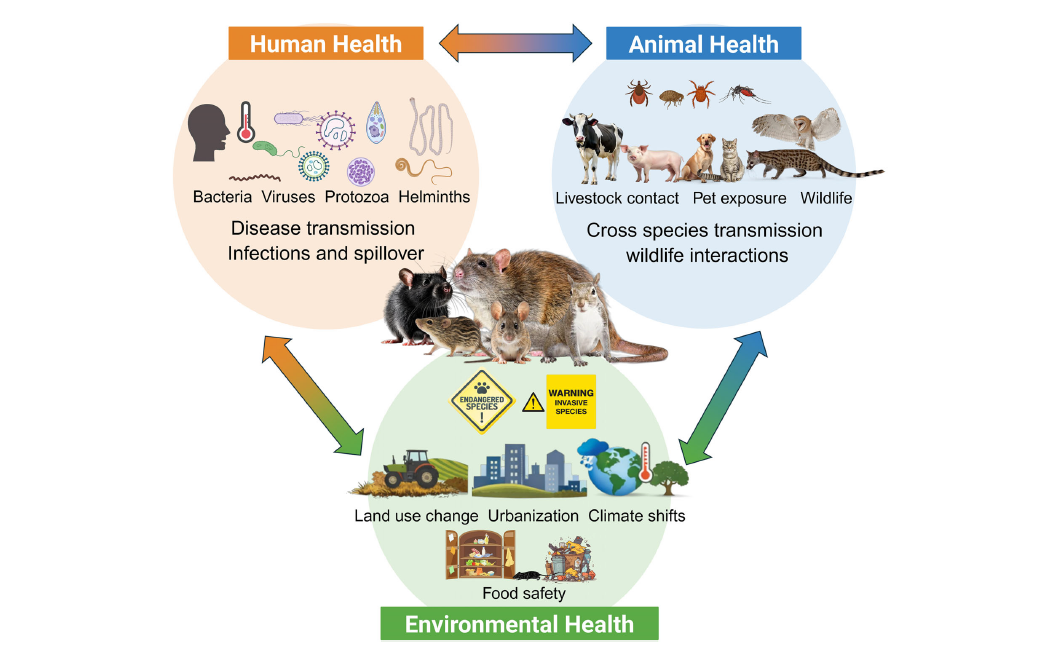
At the same time, over 60% of emerging infectious diseases affecting humans are zoonotic (originating in animals). Rodents contribute disproportionately to this burden as reservoirs of viruses, bacteria, and parasites that cause diseases such as Lyme disease, leptospirosis, plague, and hantavirus. Rodents can also disrupt ecosystems, altering microclimates, influencing vector abundance (e.g. fleas and ticks), changing contact rates among disease hosts and contributing to biodiversity loss.
The hidden toll
The paper notes that the socio-economic and health burdens of rodent infestations are deeply intertwined with poverty and social injustice. Densely populated, low-income neighbourhoods with poor sanitation and lower-quality housing face infestations that are beyond the control of individual families, leaving management in the hands of under-resourced municipalities.
Crucially, the paper highlights an often-overlooked public health challenge: the profound psychological trauma experienced by people forced to live alongside rodent infestations. Drawing on global evidence, the paper connects rodent presence to sleep disturbance, bites, nightmares, fear, social stigma, and an erosion of personal agency. Failing to address the upstream environmental causes of these human impacts places an invisible burden directly onto healthcare systems.
Pioneering One Health
For NRI, this publication synthesises a 20-plus-year legacy of research in Africa. Long before One Health became a common concept, NRI and its partners on the RatZooMan project were pioneering its principles on the ground.
The NRI-led RatZooMan project was explicitly multisectoral and international. Comprising 12 institutions in four European and four African countries, it was arguably one of the first One Health research projects focused on rodents, at a time when most applied rodent research in low-resource settings focused on smallholder agriculture.
It actively merged social anthropology – the comparative study of human societies, cultures and behaviour – with eco-epidemiological surveys, which study how ecological environments and wildlife intersect with the spread of diseases. RatZooMan can be seen as one of the first operational demonstrations of rodent-centred One Health, anticipating the formalisation of One Health as a global policy framework by nearly a decade.
Importantly, it acted as a vital catalyst. It sparked a continuous lineage of rodent-focused One Health research programmes in Africa. Collectively, these initiatives have generated one of the most substantial empirical foundations for understanding the rodent-One Health nexus worldwide.
A framework for future research and policy
This review places rodents explicitly at the centre of One Health frameworks, providing a conceptual foundation for future research, surveillance and management strategies that are both scientifically robust and socially relevant.
Looking ahead, this review positions rodent One Health as a mature but evolving field. Advances in artificial intelligence, genomics, ecological modelling and participatory research are creating new opportunities to anticipate pathogen emergence and develop more sustainable interventions. However, realising this potential will require sustained investment in long-term interdisciplinary programmes, and stronger translation of scientific evidence into policy and practice.
Read the full paper in Integrative Zoology: Putting Rodents at the Center of One Health Programs: A Narrative Synthesis